
Plumbers in Altadena
Gas Line Installation & Repair in Altadena, CA
Gas work is the one plumbing trade where there’s no room for “good enough.” A water leak ruins your drywall; a gas leak can level a house. Whether you’re adding a gas line for a new range, extending one to an outdoor kitchen, converting to a tankless water heater that demands serious BTUs, or chasing a suspected leak in an older Altadena home, this page covers how licensed pros handle it. Plumbers in Altadena connects you with California C-36 licensed plumbers who do gas work permitted, pressure-tested, and inspected — the only way it should be done. If you smell gas right now: leave the house, don’t touch any switches, and call from outside.
Gas line work often accompanies appliance upgrades — see our fixture installation service. And most gas water heaters we service are covered under water heater repair and installation.
Request Service Today
Free quotes. Licensed local plumbers. 24/7 emergency response.
Suspected Gas Leak: What Happens and What the Pro Does
The rotten-egg smell is mercaptan, added to odorless natural gas so you can detect it. If you smell it: get everyone out, don’t flip switches or light anything (even a phone call from inside is a spark risk — call from outside), and don’t try to find the source yourself. SoCalGas’s emergency line responds to suspected leaks; a licensed plumber handles the repair side. Our emergency plumbers coordinate the repair once the scene is declared safe.
What professional diagnosis looks like: the plumber shuts gas off at the meter, then performs a manometer pressure test — the system is pressurized with air, and the gauge is watched for pressure drop. If it drops, the system is isolated section by section (appliance by appliance) until the leaking section is identified. Only then does any pipe get opened. Common culprits in Altadena’s older homes: deteriorated flexible appliance connectors, corroded underground lines, unpermitted past modifications with improper fittings, and valves that no longer seal. The repair is cut-and-replace with proper materials, followed by a second pressure test proving the system holds — then the permit inspection. SoCalGas safety information is worth reviewing for every gas customer.
Adding or Extending a Gas Line: Ranges, Fire Pits, and Tankless Units
The most common gas-line projects in the foothills: running a new line for a gas range or cooktop during a kitchen remodel, extending a line to an outdoor kitchen, BBQ stub, or fire pit, adding a gas dryer, and upsizing supply for a tankless water heater or pool heater. Each one starts with the same engineering: a gas load calculation.
The calculation totals the BTU demand of every appliance on the system against the pipe’s diameter and length. A 3/4-inch line that adequately fed a furnace and water heater will starve a new 150,000+ BTU tankless unit plus a 60,000 BTU range — the symptom is appliances that underperform or shut down when multiple run at once. The fix is running a properly sized dedicated line, sometimes all the way back to the meter, and occasionally a meter upgrade coordinated with the gas utility. Underground exterior runs use polyethylene pipe with risers; interior runs use black steel or CSST (corrugated stainless steel tubing) installed to strict bonding and protection requirements. Every new or modified gas line gets pressure-tested and inspected — no exceptions.
Earthquake Shut-Off Valves: Cheap Protection for the Foothills
We live in earthquake country, and a quake-damaged gas line leaking into a damaged house is how fires start after the shaking stops. An automatic earthquake shut-off valve — installed at the meter — senses seismic motion above roughly 5.2 magnitude and shuts off gas to the entire house automatically. It resets manually once you’ve verified everything is safe.
Installation typically runs $400–$800 including the valve and labor, takes a couple of hours, and is one of the highest-value safety upgrades an Altadena homeowner can buy. Some insurers offer small discounts for them. If your home still has its original meter setup with no seismic valve, this is worth doing proactively — not after the quake. Excess-flow valves (which trip on sudden high flow from a broken line) are a related option your plumber can explain; the two devices protect against different failure modes and are sometimes installed together.
Permits, Inspections, and Why “No Paperwork” Is a Red Flag
California requires permits and inspections for gas line installation, modification, and most repairs. The inspector verifies proper materials, correct sizing, adequate supports, proper bonding of CSST, appliance shut-off valve placement, and a passing pressure test. This isn’t bureaucracy — it’s the independent verification that the system won’t kill anyone.
Treat any plumber who offers gas work “without the permit to save you money” as disqualified on the spot. Unpermitted gas work voids homeowners insurance coverage for gas-related incidents, creates massive liability at sale time (buyers’ inspectors and appraisers flag it), and — most importantly — skips the one independent check on work where mistakes are catastrophic. Legitimate gas quotes include permit handling as a line item; the fee is a few hundred dollars on a job where the stakes are everything.
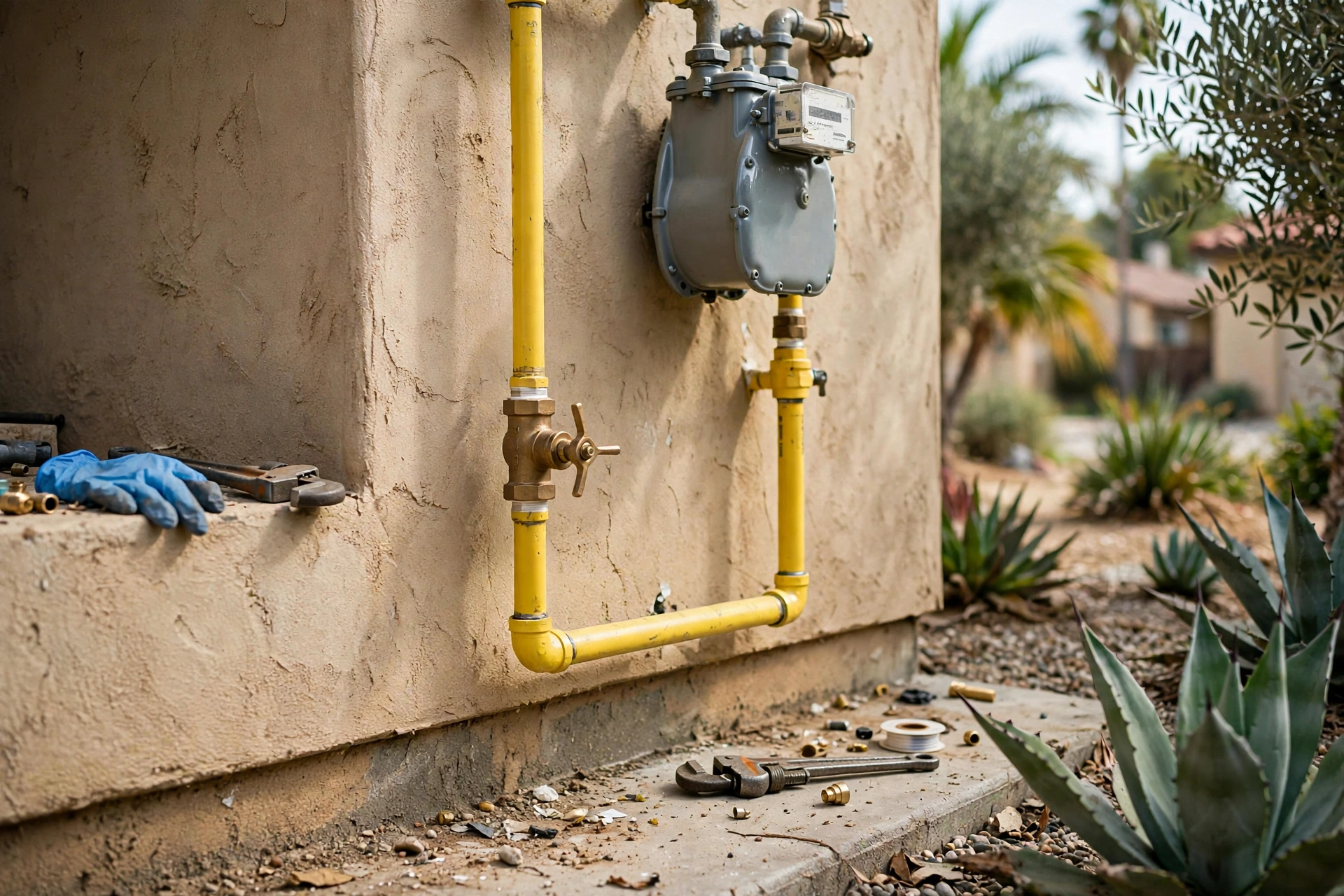
What Gas Line Work Costs in Altadena (2026)
Realistic ranges: a gas leak diagnosis with pressure testing runs $250–$500; repairing a leaking section typically runs $500–$1,500 depending on location and access. Running a new appliance line (range, dryer, BBQ stub) generally runs $500–$1,500 for a straightforward interior run; longer runs, underground exterior routing, or upsizing back to the meter run $1,500–$4,000+. Earthquake shut-off valve installation: $400–$800. A full gas-system repipe on an older home with corroded lines can run $3,000–$8,000+.
What drives price up: underground routing (trenching), long distances from the meter, difficult access through finished walls, meter upgrades, and bringing an old system up to current code (bonding, shut-off valves at each appliance). What drives it down: accessible attic or crawlspace routing, bundling with a remodel while walls are open, and combining the gas work with the appliance installation it’s serving. Get the BTU load calculation in writing with the quote — it’s the proof the sizing is engineered, not guessed.
Gas Line FAQs
What should I do if I smell gas in my house?
Leave immediately — get everyone out, don’t flip any electrical switches, don’t light anything, and don’t use your phone until you’re outside. Call SoCalGas’s emergency line or 911 from outside the house. Don’t re-enter until professionals declare it safe, and don’t try to locate the leak yourself. Once cleared, a experienced local plumber performs the pressure-test diagnosis and permitted repair.
How much does it cost to run a new gas line in Altadena?
In 2026, a straightforward new appliance line (gas range, dryer, BBQ stub) typically runs $500–$1,500 with accessible routing through an attic or crawlspace. Longer runs, underground exterior routing to an outdoor kitchen or fire pit, or upsizing back to the meter for a tankless unit run $1,500–$4,000+. Every quote should include the BTU load calculation plus permit and inspection — unpermitted gas work is a liability, not a bargain.
Do I need a permit for gas line work in California?
Yes — installation, modification, and most repairs require a permit and inspection. The inspector verifies materials, sizing, supports, CSST bonding, shut-off valve placement, and a passing pressure test. Unpermitted gas work can void your homeowners insurance for gas-related incidents and becomes a major problem at sale time. Permit fees run a few hundred dollars; skipping them is never worth it.
What is an earthquake shut-off valve and do I need one?
It’s an automatic valve at your gas meter that shuts off gas to the whole house when it senses seismic activity above roughly magnitude 5.2 — preventing gas-fed fires in a quake-damaged home. Installation runs $400–$800 and takes a couple of hours: one of the highest-value safety upgrades in the San Gabriel Valley foothills, with some insurers offering discounts. Every adult in the house should still know the manual meter valve location.
Can a plumber install a gas line, or do I need a specialist?
A California C-36 licensed plumbing contractor is the correctly licensed trade for gas piping — gas distribution within buildings falls squarely under the plumbing license. What matters is that the contractor does gas work regularly (not as a sideline), pulls permits, pressure-tests with a manometer, and welcomes inspection. Ask how many gas lines they run in a typical month; hesitation on the permit question means keep looking.
My gas bill spiked. Could I have a leak?
Possibly — but check innocent causes first: new gas appliances, heavier heating use, estimated meter readings, or a rate change. With all gas appliances off, watch your meter’s smallest dial for 15 minutes; movement indicates flow somewhere. Underground leaks often show no indoor smell but kill patches of vegetation above the line. A suspected leak warrants a professional pressure test ($250–$500) — and any gas smell means emergency protocol immediately.
How long does a gas line installation take?
Most single-appliance line installations finish in half a day to a full day: load calculation, pipe routing, pressure test, and connection. The official inspection is scheduled separately, usually within a few business days — you can typically use the line after the contractor’s own pressure test passes. Underground runs and meter upgrades take longer due to trenching and utility coordination; get a realistic timeline with the quote.
Gas Work Done Right: Permitted, Tested, Inspected.
Call (888) 555-0199 — Plumbers in Altadena will connect you with a licensed Altadena plumber for gas line installation, leak diagnosis, and earthquake valve upgrades. Smell gas right now? Leave the house and call for help from outside immediately.
Need a Plumber Right Now?
Don’t wait for a small leak to become a big bill. Our licensed local plumbers answer 24/7 — nights, weekends, and holidays.
(888) 555-0199
Average emergency response under 60 minutes across the San Gabriel Valley