
Plumbers in Altadena
Water Heater Repair & Installation in Altadena, CA
Cold shower this morning? Rusty water, a rumbling tank, or a puddle spreading under the heater? In the San Gabriel Valley foothills, water heaters live brutally short lives — our very hard water bakes sediment into tank bottoms and eats through steel in 6 to 8 years, half the lifespan you’d get with soft water. Plumbers in Altadena connects you with licensed local plumbers — experienced California plumbers — who diagnose honestly and install to code.
Considering an upgrade? Compare tankless water heater installation for endless hot water and lower energy bills — and if your heater failed catastrophically, our emergency plumbers respond around the clock.
Request Service Today
Free quotes. Licensed local plumbers. 24/7 emergency response.
No Hot Water? Start With the Simple Checks
Before you call anyone, run through the basics — a surprising number of “dead” water heaters aren’t dead at all. For gas units: is the pilot lit? A pilot that went out in a draft can simply be relit following the instructions on the unit. For electric: check the breaker — a tripped breaker or a tripped high-limit reset button (the red button behind the upper access panel) points to a thermostat or element issue, not a dead tank.
If the pilot won’t stay lit, the usual suspect is the thermocouple — a small safety sensor that shuts off gas when the flame goes out. It’s a cheap part and a quick fix. If an electric heater trips its breaker repeatedly, one of the heating elements has likely failed and is shorting — also a straightforward repair.
Rumbling, Popping, and Banging: Sediment Is Killing Your Tank
That kettle-like rumbling when the burner fires is the signature sound of Altadena hard water. Dissolved minerals precipitate out of heated water and settle as sediment on the tank bottom — sometimes inches thick. The burner then superheats trapped water under the sediment layer, which flashes to steam and pops. It’s loud, it’s inefficient, and it overheats the tank bottom until the steel weakens and fails.
The fix, if caught early: a full tank flush and descaling, plus checking the anode rod — the sacrificial magnesium or aluminum rod inside the tank that corrodes so the tank doesn’t. In hard-water areas the anode can be consumed in 3–4 years; replacing it is the single highest-value maintenance a water heater can get.
Rusty or Smelly Hot Water: What It’s Telling You
Rusty hot water (but clear cold water) means the inside of your tank is corroding — the glass lining has cracked and the steel is rusting. A rotten-egg smell in hot water only means sulfur bacteria are reacting with a depleted anode rod. These are different problems with different fixes.
For rust: check the anode rod first — if there’s rod left, replacing it can buy time, but visible rust in the hot water usually means the tank is in its final year or two. Start planning the replacement rather than being surprised by a rupture. For odor: replacing the standard anode with a zinc-aluminum alloy rod usually kills the smell, sometimes combined with a chlorination flush.
Water Under the Heater: Repair or Replace?
First, verify the source — water under a heater isn’t always a failed tank. Condensation, a leaking temperature-and-pressure (T&P) relief valve, loose plumbing connections, or a failed drain valve all drip water that pools underneath.
But if water is seeping from the tank body itself — the bottom seam, the sidewall, or around the base — the tank has failed and cannot be repaired. No epoxy, no patch, no sealant holds a pressurized, heated steel tank; anyone offering one is selling you a flood. Replacement means sizing correctly, hauling the old unit, and installing to California code: seismic strapping, drain pan, expansion tank, and proper gas venting. If the tank ruptured and flooded the area, our emergency plumber line handles same-day replacement.
Repair or Replace? The Decision Framework
This is the question every water heater call comes down to. Here’s how honest plumbers think through it:
Repair it when: the unit is under 6 years old; the problem is a single failed component (thermocouple, element, thermostat, gas valve, T&P valve); the tank shows no rust in the hot water; and the repair costs less than about a third of replacement. A $200 thermocouple on a 4-year-old heater is a no-brainer.
Replace it when: the tank is 8+ years old in our hard water (you’re past design life — repairs buy months, not years); there’s any rust in the hot water; the tank body itself leaks; you’ve already repaired it once in the past year; or the repair quote exceeds half the replacement cost. A $500 gas valve on a 9-year-old tank is throwing money at a heater that’s already dying.
The gray zone (6–8 years): weigh the repair cost against remaining life. A cheap fix on a 7-year-old unit that’s otherwise healthy can make sense — but go in eyes open that replacement is likely within 2 years, and don’t let a small repair turn into a $900 parts cascade.
Choosing the Right Replacement: Size, Fuel, and Tank vs. Tankless
Most Altadena homes run a 40- or 50-gallon gas tank heater; the right size depends on household demand, not just the old unit’s label. A family of four with teenagers taking back-to-back showers needs more first-hour delivery than a retired couple.
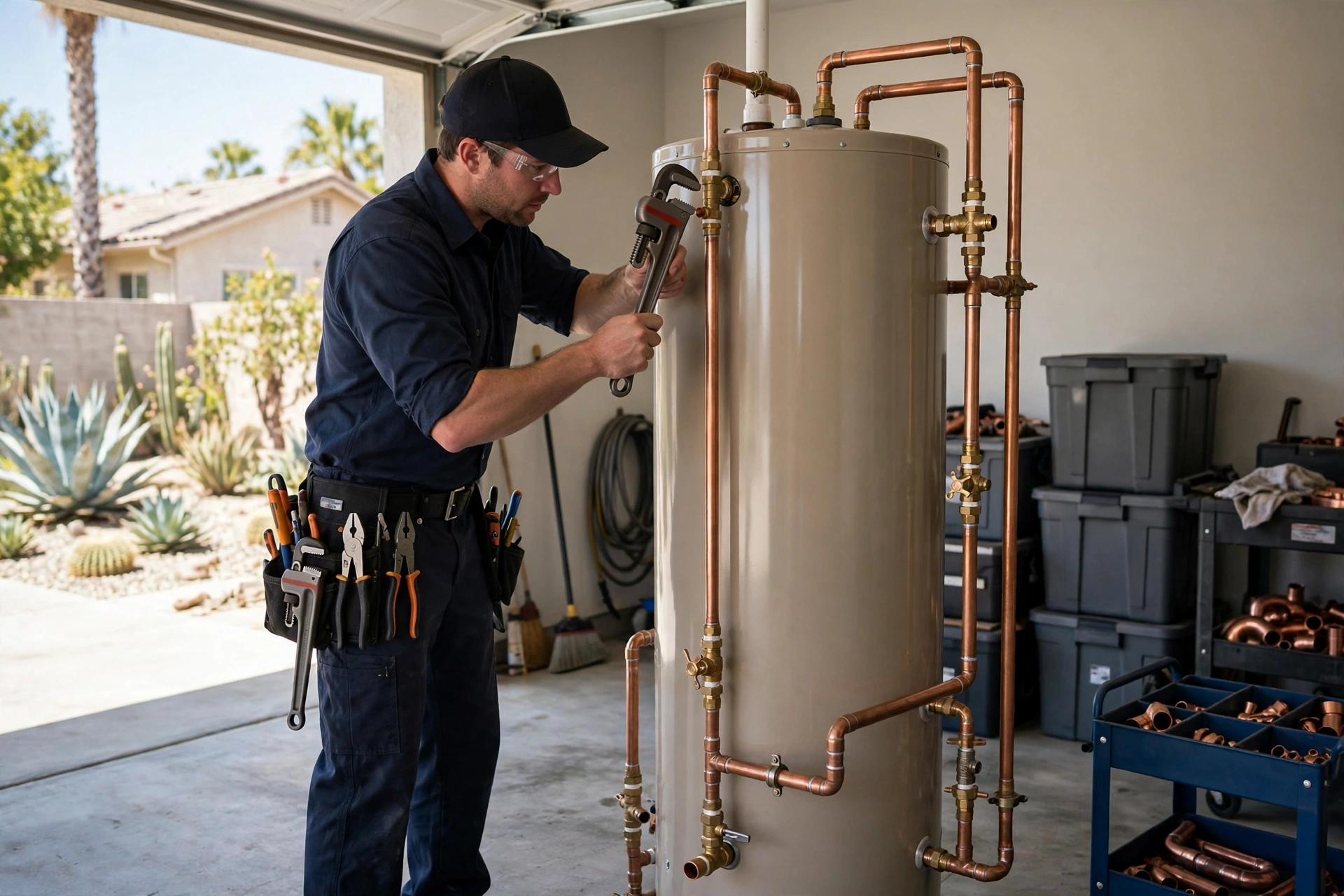
Fuel matters too: gas heats faster and costs less to run here; electric is simpler to install where gas isn’t available. And for many homes, the replacement conversation should include going tankless — endless hot water, a fraction of the footprint, and 20+ year lifespans, though with higher upfront cost and a gas-line upgrade in many retrofits. Energy.gov’s water heating guide is a solid neutral reference on efficiency ratings.
What Water Heater Work Costs in Altadena
Honest 2026 ranges: a simple repair (thermocouple, element, thermostat, relief valve) typically runs $150–$450 including parts. A standard 40–50 gallon gas tank replacement, installed to California code with permit, seismic strapping, drain pan, and thermal expansion tank, generally lands between $1,800 and $3,500 — the unit itself, the permit, and code upgrades are most of the cost, not the labor hours.
What drives price up: difficult access (attic or tight closet installs add labor), bringing ancient venting or undersized gas lines up to code, high municipal water pressure requiring a PRV (pressure-reducing valve) plus expansion tank to protect the new heater, and emergency after-hours replacement. What drives it down: replacing before it ruptures — a planned swap is always cheaper than a 2 a.m. emergency plus water damage — and bundling with other work like a repipe. Permits are required in California for water heater replacement; the inspection protects you on insurance and resale, so treat it as non-negotiable, not optional.
The U.S. Department of Energy’s water heating guide explains how water heater efficiency ratings work — useful when comparing repair vs. replacement.
Water Heater FAQs
How long does a water heater last in Altadena?
With our very hard water, 6–8 years is typical for a tank heater without maintenance — about half the soft-water lifespan. Annual flushing plus anode rod replacement every 3–4 years stretches that to 10–12 years. Tankless units last 20+ years with descaling. If your tank is past year 8 and acting up, put repair money toward replacement.
Why is my water heater making rumbling noises?
Sediment baked onto the tank bottom. The burner superheats water trapped under the sediment, which flashes to steam and pops loudly. A full flush fixes it if caught early — long-neglected sediment sometimes won’t fully clear. Rumbling also warns the tank bottom is weakening; failure often follows within a year or two.
Can a leaking water heater be repaired?
If the leak is from a valve, fitting, or connection — yes, a cheap fix. If water seeps from the tank body itself, no: the steel has failed, and no epoxy or sealant is safe on a pressurized hot tank. Verify the source first — condensation and T&P relief-valve drips mimic tank leaks.
What size water heater do I need?
Size to peak-hour demand, not square footage. A 40-gallon tank suits 1–2 people; 50 gallons covers most families of 3–4; larger households or soaking tubs may need 75 gallons or tankless. Check the first-hour rating, not just tank size — and make the installer ask about your actual usage rather than just matching the old label.
Do I need a permit to replace a water heater in California?
Yes. California requires a permit and inspection covering seismic strapping, venting, T&P discharge routing, drain pan, and expansion tank. Unpermitted installs risk insurance denials and resale headaches — inspectors flag them routinely. Legitimate installers pull the permit as part of the job; expect roughly $100–$300 in permit fees.
My hot water smells like rotten eggs. What’s wrong?
Sulfur bacteria reacting with a depleted anode rod — a water-chemistry issue, not sewage; the cold water usually smells fine. Replacing the standard anode with a zinc-aluminum alloy rod fixes most cases, sometimes with a chlorination flush. If the smell persists, the bacteria are in the supply itself — a water-treatment conversation, not a heater problem.
Should I repair my 10-year-old heater or replace it?
Replace it. At 10+ years in Altadena’s hard water you’re past design life — a $300–$500 repair buys months, and the tank could rupture meanwhile. Put that money toward a new unit with a fresh warranty, and price a tankless conversion alongside for an honest 20-year comparison.
No Hot Water — or a Tank That’s Failing? Get It Fixed Today.
Call (888) 555-0199 — Plumbers in Altadena will connect you with a licensed Altadena plumber for honest water heater diagnosis, same-day replacement, and tankless options. Leaking tank flooding the garage? Call our 24/7 emergency line.
Woke Up to a Flood at 2:30 AM?
Water heater ruptures do not check the clock. The most common emergency call we get sounds like this: “I woke up in the middle of the night and there was water everywhere.” A failed tank can dump 40 to 50 gallons across your floor in minutes, and every minute matters. First move: shut off the cold-water supply valve above the heater (turn it clockwise), then kill power at the breaker for electric units or turn the gas control to “pilot” or “off.” Then call — our emergency line is answered around the clock, and a ruptured heater gets priority dispatch because standing water damages flooring, drywall, and anything stored nearby by the hour.
What Is It Going to Cost to Replace My Water Heater?
The honest answer: it depends on what you are replacing and what the install requires. A straightforward like-for-like tank swap typically runs less than a conversion to tankless, which may need gas line upsizing and new venting. What drives the price is not just the unit — code-required seismic strapping, drain pan, expansion tank, permit, and haul-away of the old heater are all part of a proper job. Be wary of quotes that seem too cheap; they usually skip the permit, the pan, or the strapping. Call for an upfront price before we start. You will know the full number, not a “starting at” teaser.
Need a Plumber Right Now?
Don’t wait for a small leak to become a big bill. Our licensed local plumbers answer 24/7 — nights, weekends, and holidays.
(888) 555-0199
Average emergency response under 60 minutes across the San Gabriel Valley