
Plumbers in Altadena
Leak Detection & Slab Leak Repair in Altadena, CA
Your water bill doubled but your habits didn’t change. There’s a warm spot on the tile floor. You hear water running when every tap is off. Hidden leaks are the most financially dangerous plumbing problems because they destroy silently — soaking slabs, framing, and foundations for weeks before anyone notices. This page is for Altadena homeowners chasing the signs of a leak they can’t see. Plumbers in Altadena connects you with licensed local plumbers — experienced California plumbers — who find leaks with instruments, not jackhammers, and fix them with the least destruction possible.
Found an active leak? Our emergency plumbers can be on-site fast. If leaks keep recurring in an aging system, a whole-house repipe may cost less long-term than repeated repairs.
Request Service Today
Free quotes. Licensed local plumbers. 24/7 emergency response.
The Signs You’re Dealing With a Hidden Leak
Hidden leaks announce themselves indirectly. Watch for: a water bill that jumps 30%+ with no usage change (the single most reliable indicator — check your meter); the sound of running water with all fixtures off; warm or damp spots on floors; new cracks in tile or lifting flooring; musty smells in a specific area; a water heater that runs constantly; or lush, soggy patches in the yard over the supply line’s path.
Before calling, do the meter test: turn off everything in the house, note the meter reading, wait 30–60 minutes without using water, and read it again. If it moved, water is escaping somewhere — and you have a confirmed leak, not a high bill from a running toilet (check toilets first with food coloring in the tank; a silent flapper leak wastes hundreds of gallons a day and mimics a hidden leak).
How Pros Actually Find Leaks (No Guesswork, No Random Digging)
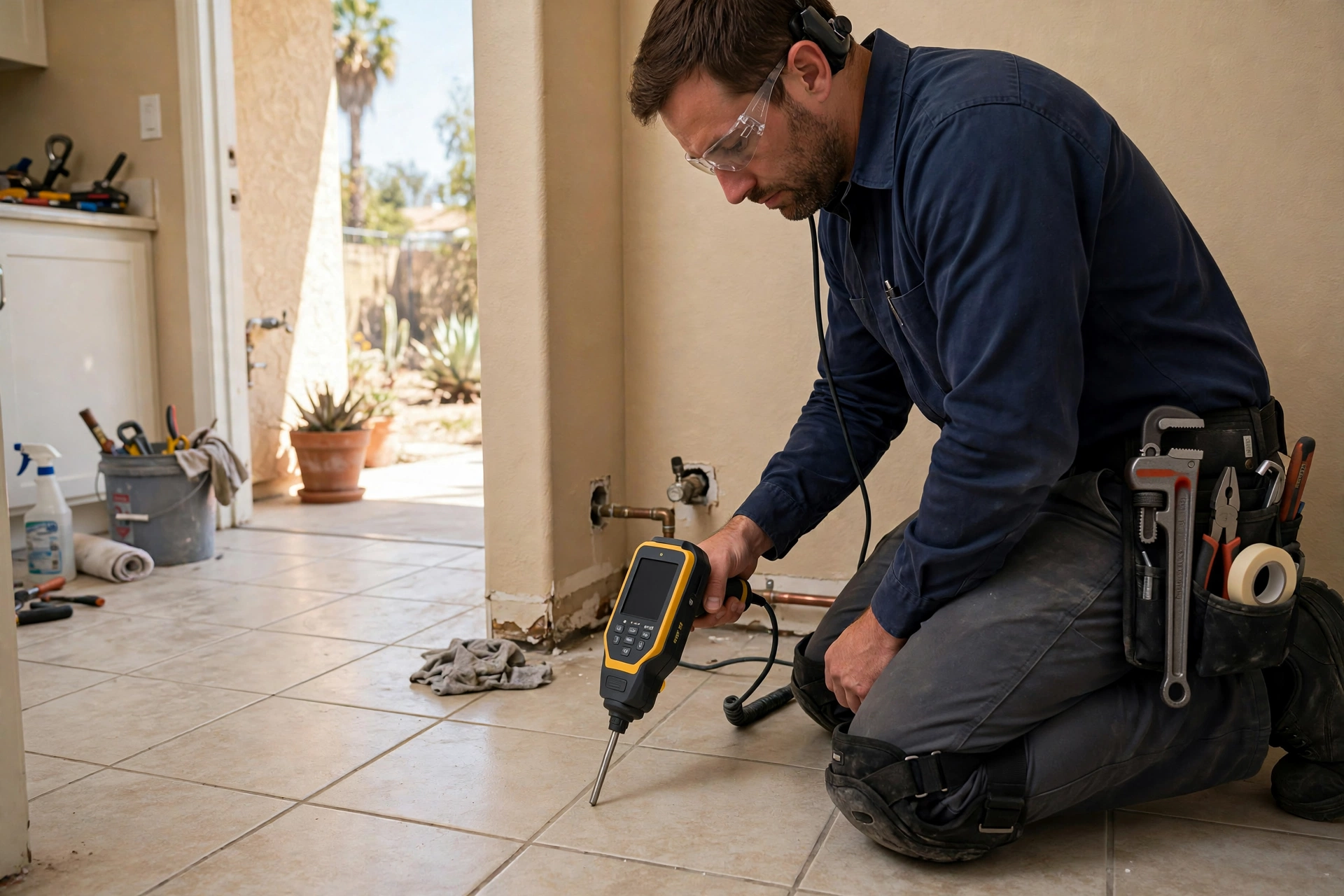
Professional leak detection is a diagnostic discipline with real instruments. Here’s the toolkit and what each one does:
- Acoustic listening: ultra-sensitive ground microphones and headphones that amplify the hiss of pressurized water escaping a pipe. The tech maps the loudest point — often within inches — through slab or soil. This is the primary tool for slab leaks.
- Thermal imaging: infrared cameras that reveal temperature anomalies — a hot-water slab leak shows as a warm plume spreading through the concrete. Fast, non-invasive, and excellent for narrowing the search area.
- Pressure testing and isolation: the system is pressurized and isolated section by section. If the hot side holds pressure but the cold side drops, the leak is on the cold side — halving the search area before any instrument comes out.
- Moisture meters and borescopes: pin-type meters confirm dampness inside walls; tiny cameras inspect inside wall cavities through a half-inch hole instead of opening the whole wall.
- Tracer gas: for stubborn cases, the line is filled with a harmless hydrogen-nitrogen mix and a sniffer detects where it surfaces — accurate to inches even under deep slab.
Slab Leaks: Spot Repair, Reroute, or Repipe?
Altadena has plenty of mid-century slab-on-grade homes, and slab leaks — pressurized supply lines failing under the concrete — are their signature nightmare. Once the leak is pinpointed, three fixes exist, and the right one depends on the pipe’s overall condition:
Spot repair ($800–$2,500): jackhammer a small opening at the marked location, cut out the failed section, and repair it. Makes sense when the pipe is otherwise healthy (copper in good shape, first leak, isolated cause like a kink or abrasion). The downside: you’re opening slab, and if the system is aging, the next leak is a matter of time.
Reroute ($1,500–$4,000): abandon the under-slab line entirely and run a new PEX or copper line overhead through walls and attic to the affected fixtures. No slab demolition, and the new line is accessible for the future. This is the sweet spot for a single failed under-slab run in an otherwise okay system — increasingly the default recommendation.
Full repipe ($5,000–$15,000+): when detection finds (or history shows) multiple leaks, or the under-slab system is galvanized or aging copper with systemic corrosion. If you’re jackhammering the slab twice, you’ve spent reroute money and still own failing pipe. See our whole-house repipe framework for the full decision logic.
The decision rule: first slab leak in a healthy copper system → spot repair or reroute. Second leak, or any leak in galvanized → reroute at minimum, and price the full repipe. Never spot-repair the same failing system twice.
Pinhole Leaks in Walls: The Altadena Special
In foothill homes with original copper or galvanized supply lines, pinhole leaks inside walls are the most common hidden leak we see. A pinhole starts as a weep — barely enough to notice — and soaks insulation, drywall, and framing for weeks. By the time the stain appears on the ceiling below, the damage is extensive.
Detection here combines moisture-meter mapping (tracing the damp gradient uphill to the source) with targeted borescope inspection — a half-inch hole instead of a demolished wall. The repair itself is usually straightforward: open a surgical section of drywall, replace the failed pipe section, and — critically — assess the rest of the run. One pinhole in galvanized means the system is talking to you; listen the first time. If the failed section is part of a corroded galvanized run, the honest recommendation is repiping that run, not patching it.
What Leak Detection and Repair Costs (2026)
Detection: $250–$500 for a full instrument survey with a marked location — money well spent, since it converts a jackhammer-everywhere job into a surgical one. Spot repairs: $800–$2,500 depending on access (under-slab costs more than in-wall). Reroutes: $1,500–$4,000 depending on distance and fixture count. Full repipes: $5,000–$15,000+.
What drives price up: slab access (concrete cutting, dust control), leaks under finished flooring that must be matched afterward, and multiple leaks found during the survey. What drives it down: accurate detection (every hour of searching you avoid is money saved), accessible attic or crawlspace routing for reroutes, and catching it early — a $300 detection visit beats a $5,000 mold remediation every time.
Leak Detection & Slab Leak FAQs
How do I know if I have a slab leak?
The classic signs: a warm or damp spot on the floor, the sound of running water with all fixtures off, a water bill that spikes without usage changes, cracked tile, or a constantly running water heater. Confirm with the meter test — turn everything off for an hour; if the meter moves, you have a confirmed leak. Hot-side leaks show warmth; cold-side leaks show only dampness or sound — which is why thermal imaging plus acoustic listening is the standard diagnostic pair.
How much does leak detection cost?
A professional instrument survey — acoustic listening, thermal imaging, pressure isolation, with the leak location marked — typically runs $250–$500 in the San Gabriel Valley, usually credited toward the repair. Be wary of “free leak detection”: the cost is real, and free usually means it’s buried in an inflated repair quote or the diagnosis is rushed. A proper survey takes 1–2 hours.
Do you have to tear up my whole floor to fix a slab leak?
No — that’s the old way. Modern practice is pinpoint detection first (usually within inches), then either a surgical spot repair through a small slab opening or a reroute that abandons the under-slab line and runs new pipe through walls and attic — zero slab demolition. Full tear-outs happen only when detection was skipped or the system is failing in multiple places, in which case a repipe is the honest answer anyway.
What’s better for a slab leak: spot repair or reroute?
It depends on the pipe’s condition. Spot repair ($800–$2,500) fits a first leak in an otherwise healthy copper system — isolated cause, good pipe elsewhere. Reroute ($1,500–$4,000) is better for an aging system: no slab demolition, the new line stays accessible, and you stop playing whack-a-mole with the next leak. The rule: never spot-repair the same failing system twice.
Will homeowners insurance cover a slab leak?
Often partially. Most policies cover resulting water damage from sudden, accidental leaks but exclude the pipe repair itself — and slow, long-term leaks may be denied as maintenance issues. Document everything: photos, the plumber’s written detection findings, and meter readings, and file promptly. Coverage varies enormously, so read the sudden-versus-gradual language in your policy before you need it.
My water bill doubled but I can’t find a leak. What should I do?
Start with the free checks: dye-test every toilet tank (a silent flapper leak is the #1 cause of mystery water loss), check the water heater’s relief-valve discharge, and inspect the irrigation system — a stuck zone valve can dump thousands of gallons underground invisibly. Then run the meter test with everything off. If the meter moves and the toilets are innocent, you have a supply-side leak and it’s time for professional detection.
Can a slab leak cause foundation damage?
Yes, if left running. A pressurized leak under the slab erodes the supporting soil, creating voids that let the slab settle and crack — and on Altadena’s hillsides, undermined soil can alter drainage around the foundation. The concrete isn’t attacked directly; it’s the soil loss underneath that causes settling. A suspected slab leak is urgent even when nothing looks damaged yet — every week of flow washes away more soil.
Suspect a Hidden Leak? Find It Before It Finds Your Foundation.
Call (888) 555-0199 — Plumbers in Altadena will connect you with a licensed Altadena plumber for instrument-accurate leak detection and least-destruction repair. Hearing water right now with everything off? That’s urgent — call our 24/7 emergency line immediately.
Your Water Utility Already Told You: Read the Alert
More leak-detection calls start with a letter or alert from the water company than with any visible symptom. If your utility contacts you about unusual usage, or your bill jumps suddenly — we have seen customers go from $80 to $500+ in a single cycle — treat it as a confirmed lead, not a billing error. Smart meters flag continuous flow patterns that match hidden leaks with remarkable accuracy. Do not wait for a second high bill to “make sure.” Every week of delay is water and money disappearing into the ground, and in slab-on-grade homes, prolonged leaks erode soil under the foundation.
Can I Just Get the Leak Located and Fix It Myself?
Yes — detection-only service is a real option, and we are upfront about it. Some homeowners want a professional pinpoint (within inches, marked on the floor or wall) and then handle the repair themselves or hand it to their own contractor. You pay for the diagnostic visit, get a written location report, and that is it. What we will not do is pretend a vague “somewhere in this area” is good enough to dig on. If you are opening concrete or walls based on our mark, it needs to be right.
Need a Plumber Right Now?
Don’t wait for a small leak to become a big bill. Our licensed local plumbers answer 24/7 — nights, weekends, and holidays.
(888) 555-0199
Average emergency response under 60 minutes across the San Gabriel Valley