
Plumbers in Altadena
Tankless Water Heater Installation in Altadena, CA
Endless hot water, a unit the size of a suitcase instead of a 50-gallon tank, and energy bills that drop because you’re not keeping 50 gallons hot around the clock — that’s the tankless pitch, and most of it is true. But tankless isn’t plug-and-play: it demands serious gas supply, proper venting, and regular descaling in our hard water. This page is for Altadena homeowners weighing the switch. Plumbers in Altadena connects you with licensed local plumbers — experienced California plumbers — who install tankless systems correctly, including the gas and venting upgrades most retrofits need.
Not sure tankless is right for your home? Our tank water heater repair and installation page covers conventional options — and most replacements pair well with new fixture installations.
Request Service Today
Free quotes. Licensed local plumbers. 24/7 emergency response.
How Tankless Actually Works (and What “Endless” Really Means)
A tankless unit heats water on demand: when you open a hot tap, a flow sensor fires a high-powered burner (often 150,000–199,000 BTU — three to four times a standard tank heater) that heats water as it passes through a heat exchanger. Close the tap, the burner shuts off. No standby heat loss, no running out mid-shower — the “endless” part is real.
The honest caveat: endless doesn’t mean unlimited simultaneous use. Every unit has a maximum flow rate (gallons per minute) at a given temperature rise. In winter, when incoming groundwater is colder, the temperature rise needed is bigger and the effective GPM drops. A pro sizes the unit to your real peak demand — showers plus dishwasher plus laundry running at once — and will tell you straight when a household needs two units in parallel or a larger model rather than the base unit. Undersized tankless is the number one cause of “lukewarm shower” complaints.
The Gas Line Problem Nobody Mentions in the Brochure
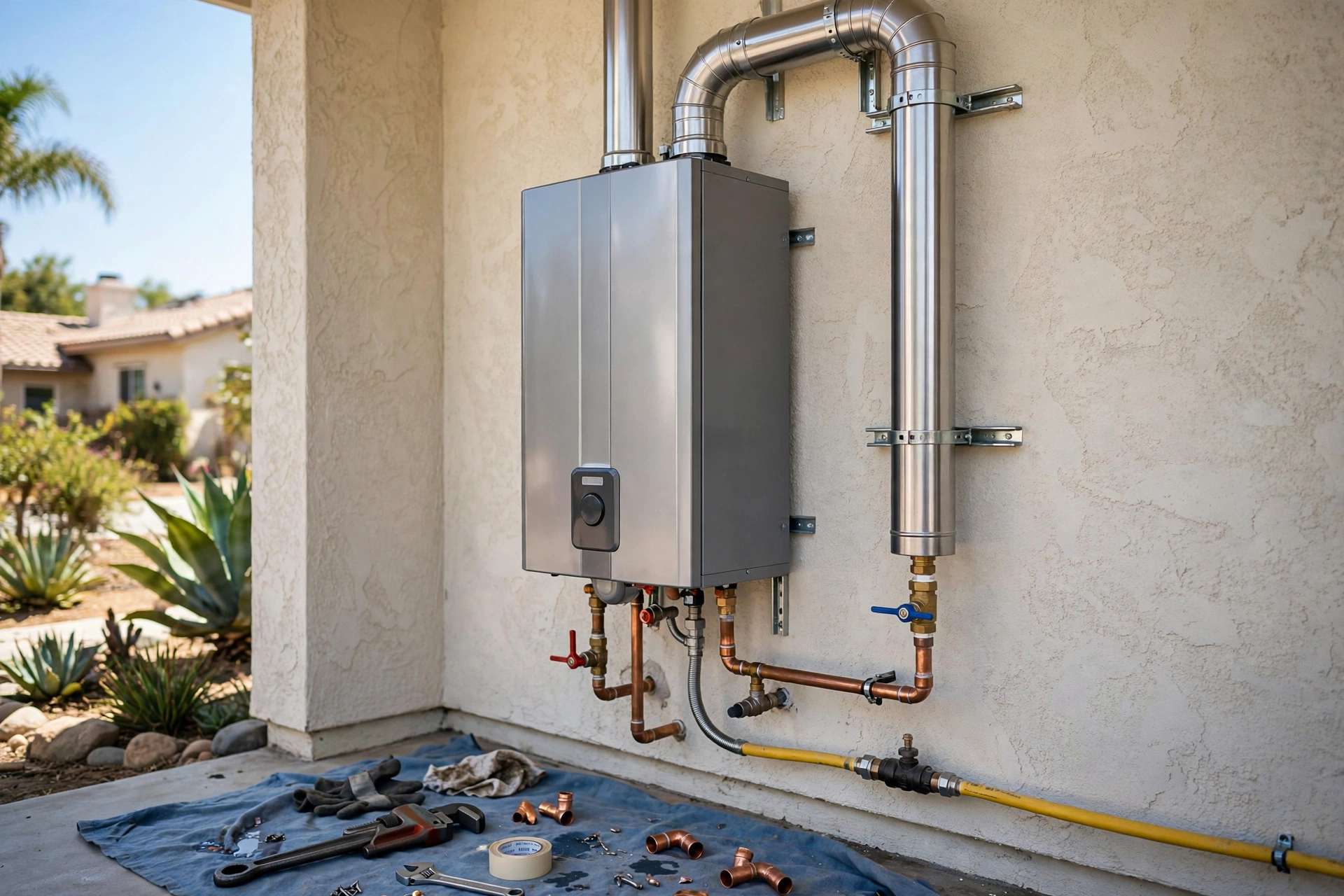
Here’s the retrofit reality most quotes gloss over: your existing gas line was sized for a 40,000 BTU tank heater, and a tankless unit wants 150,000+ BTU. In most Altadena retrofits, the gas line from the meter must be upsized — sometimes all the way back to the meter — or the unit will starve for gas, soot up, and throw error codes.
A proper installer does a gas load calculation: total BTU of every appliance, pipe length, and diameter. The fix is running a larger dedicated gas line to the unit, and occasionally upgrading the meter itself through the gas utility. This is real gas line work — permitted, pressure-tested, and inspected. Any quote for tankless installation that doesn’t mention the gas line is either incomplete or planning a surprise change order. Ask directly: “Is my gas line adequate, and is the upgrade in this quote?”
Venting: The Other Hidden Retrofit Cost
Tank heaters use a simple metal flue; tankless units — especially high-efficiency condensing models — need sealed stainless steel or PVC venting, often routed differently through the wall or roof. Condensing units also produce acidic condensate that must be drained through a neutralizer, not just dumped on the ground.
What the pro does: evaluate the current vent path, determine whether the existing flue can be reused (usually not for condensing units), and route new sealed venting with proper clearances from windows, doors, and air intakes per code. Outdoor-mounted units sidestep venting entirely and are popular in our climate — no freeze risk in Altadena — but they need proper gas supply and weather protection. Venting done wrong causes carbon monoxide hazards and failed inspections; this is not the place to cut corners.
Hard Water vs. Tankless: Descaling Is Non-Negotiable
Altadena’s very hard water is the enemy of tankless heat exchangers. Scale coats the narrow waterways inside the unit, strangling efficiency and eventually triggering shutdowns — an unmaintained tankless in hard water can fail in as little as 5 years, while a maintained one runs 20+.
The solution has two parts. First, annual (sometimes twice-yearly here) descaling: the pro isolates the unit with service valves — insist these get installed, because flushing without them is a nightmare — and circulates food-grade vinegar or descaling solution through the heat exchanger for 45–60 minutes. Second, consider a whole-house scale-reduction system or water softener upstream; it protects not just the tankless but every fixture and appliance in the home. Factor maintenance into your decision honestly: tankless saves energy but demands attention that a tank heater doesn’t.
What Tankless Installation Really Costs in Altadena
Straight 2026 numbers: the unit itself runs roughly $1,000–$2,500 depending on capacity and efficiency. A full tank-to-tankless conversion — unit, gas line upsizing, new sealed venting, condensate neutralizer and drain, permit, and inspection — typically lands between $3,500 and $7,500 in the San Gabriel Valley. Replacing an existing tankless unit runs considerably less ($1,500–$3,000) since the gas and venting infrastructure is already in place.
What drives price up: long gas-line runs back to the meter, a meter upgrade through the gas utility, complex vent routing through finished walls, and condensate handling. What drives it down: an existing adequate gas line (rare but it happens), outdoor mounting that eliminates venting costs, and scheduling as a planned project rather than an emergency. Get an itemized quote — unit, gas work, venting, permit shown separately — and compare the 20-year math: higher upfront cost, 25–35% lower energy bills, and double-plus the lifespan of a tank.
Tank vs. Tankless: The Decision Framework
Go tankless when: your household regularly runs out of hot water; you’re a long-term owner (10+ years) who’ll recoup the investment through energy savings and avoided replacements; the tank eats valuable space; or you’re adding demand like an ADU or a big soaking tub. The 20-year math — one tankless versus two to three tank replacements plus lower gas bills — usually wins clearly here.
Stick with a tank when: your household is small with modest hot-water use (you may never recoup a $5,000+ conversion); the gas-line upgrade cost dwarfs the projected savings; it’s a rental where annual descaling won’t happen; or you’re selling within a few years. A high-efficiency tank replacement ($1,800–$3,500 installed) is a perfectly respectable answer — see our water heater page.
The gray zone: moderate-use households planning to stay 5–10 years. Here it comes down to the gas-work quote: if your gas line is already adequate or the run is short, tankless often pencils out; if the line needs a full re-run back to the meter, the payback stretches thin. Get the itemized quote first, then decide — never decide first and discover the gas work later.
Before choosing, review the Department of Energy’s water heating efficiency data — tankless units shine in the right household, but sizing matters.
Tankless Water Heater FAQs
How much does tankless water heater installation cost in Altadena?
In 2026, a full tank-to-tankless conversion in the San Gabriel Valley typically runs $3,500–$7,500 all-in: the unit ($1,000–$2,500), gas line upsizing, new sealed venting, condensate handling, permit, and inspection. The gas and venting work frequently costs as much as the unit itself. Replacing an existing tankless unit runs $1,500–$3,000 — get itemized quotes with unit, gas, venting, and permit shown separately.
Will I really never run out of hot water?
Yes, with proper sizing — a tankless unit heats continuously as long as water flows. The real limit is simultaneous demand: every unit has a maximum GPM rating, and colder winter groundwater means a bigger temperature rise and lower effective output. Two showers plus laundry in January can overwhelm an undersized unit — size to your real peak demand, not the brochure number.
Does my gas line need to be upgraded for tankless?
In most retrofits, yes. Tankless units draw 150,000–199,000 BTU versus ~40,000 for a tank heater, and existing gas lines were sized for the smaller load. A proper installer performs a gas load calculation and includes the upsized, pressure-tested line in the quote. Any tankless quote that never mentions the gas line is incomplete — ask directly before signing.
How often does a tankless unit need maintenance in hard water?
At least once a year in Altadena — many households need it twice yearly. Descaling means 45–60 minutes circulating solution through the heat exchanger via service valves (insist these get installed). Skipping maintenance voids most manufacturer warranties and can kill a unit in as little as 5 years here. A softener or scale-reduction system upstream extends service intervals.
How long do tankless water heaters last?
20+ years with regular descaling — roughly double to triple a tank heater’s lifespan in our hard water. The heat exchanger typically carries a 12–15 year manufacturer warranty, other parts around 5 years, with labor coverage varying by installer (usually 1–2 years — ask, because labor is the expensive part of any warranty claim). Units that die young almost always died of neglected scale.
Can a tankless unit be installed outdoors?
Yes, and it’s popular in our climate since Altadena doesn’t freeze. Outdoor mounting eliminates sealed-venting costs and frees indoor space. The unit still needs adequate gas supply, electrical for the controls and freeze protection, proper clearances, and shielding from direct sprinkler spray. In rebuild areas, confirm placement meets current code with your installer.
Tankless vs. tank: which saves more money?
Tankless wins on energy — no standby losses, typically 25–35% more efficient — and on lifespan. But the upfront cost is roughly double. Long-term owners with high hot-water demand usually win the 20-year math (one tankless versus two to three tank replacements plus lower gas bills); small households or near-term sellers usually do better with a standard tank. Run your actual numbers; don’t buy on brochure math.
Thinking About Going Tankless? Get an Honest Assessment.
Call (888) 555-0199 — Plumbers in Altadena will connect you with a licensed Altadena plumber for proper sizing, a gas-line evaluation, and an itemized tankless quote with no surprises.
Need a Plumber Right Now?
Don’t wait for a small leak to become a big bill. Our licensed local plumbers answer 24/7 — nights, weekends, and holidays.
(888) 555-0199
Average emergency response under 60 minutes across the San Gabriel Valley