
Plumbers in Altadena
Trenchless Sewer Repair in Altadena, CA
Your sewer lateral is failing, and the thought of a backhoe tearing through your driveway, your mature landscaping, and the patio you just paid for is almost worse than the repair bill. Trenchless sewer repair exists for exactly this situation: replacing or rehabilitating your sewer line with little to no digging. Plumbers in Altadena connects you with licensed local plumbers — experienced California plumbers — who offer both trenchless and traditional methods and recommend based on your pipe, not their equipment.
Not every line qualifies for trenchless methods — see when traditional sewer replacement is the better call. Older foothill homes often need a whole-house repipe at the same time.
Request Service Today
Free quotes. Licensed local plumbers. 24/7 emergency response.
Pipe Bursting vs. Pipe Lining: The Two Trenchless Methods
“Trenchless” covers two genuinely different technologies, and which one fits depends on your pipe’s condition:
Pipe bursting replaces the pipe entirely. A bursting head is pulled through the old line, fracturing it outward while simultaneously dragging a brand-new seamless HDPE pipe into place behind it. You end up with a completely new, jointless, root-proof pipe — often slightly larger in diameter than the original. It requires only small entry and exit pits. This is the right choice when the old pipe is too far gone to serve as a host: collapsed sections, badly offset joints, or Orangeburg that’s deforming.
CIPP lining (cured-in-place pipe) rehabilitates the existing pipe. A resin-saturated felt or fiberglass liner is inverted into the old pipe, inflated tight against its walls, and cured — with hot water, steam, or UV light — into a hard, smooth “pipe within a pipe.” The old pipe becomes a form; the liner becomes the working pipe, jointless and root-resistant with a 50-year design life. Lining needs the old pipe to be structurally intact enough to hold the liner during curing, and it reduces the interior diameter slightly (usually negligible for flow).
When Trenchless Is the Right Call
Trenchless shines in the situations Altadena serves up constantly: laterals running under expensive surfaces — concrete driveways, paver patios, mature trees you’d pay thousands to remove and replace, hillside landscaping where excavation risks destabilizing a slope. In these cases trenchless isn’t just less disruptive, it’s often cheaper overall, because open-trench quotes don’t include restoring what the trench destroyed.
It’s also the right call for long laterals (60+ feet), where per-foot trenchless pricing beats per-foot excavation, and for pipes with good “bones” but bad joints — classic clay pipe with root intrusion at every joint is an ideal lining candidate. The project typically finishes in 1–2 days versus 3–5 for open trench, with your landscaping intact and only small pits to backfill.
When Traditional Excavation Still Beats Trenchless
Open-trench excavation is still the better choice when:
- The pipe has collapsed completely. A liner needs a host pipe to press against; a bursting head needs a path to follow. Fully collapsed sections with no remaining channel often can’t be navigated trenchlessly.
- The line needs regrading. Trenchless follows the old pipe’s path — including its bellies and bad slope. If the camera shows chronic bellies holding standing water, only excavation lets the plumber re-establish proper fall. Lining a belly just gives you a smooth belly that still holds water.
- Access is blocked by structures. If the lateral runs under a building addition, a pool, or a retaining wall with no viable pit locations, there may be no way to get the equipment in — and bursting under a structure risks damage.
- The pipe is too shallow or the run is very short. Trenchless equipment has mobilization costs; for a 20-foot shallow run under plain dirt, open trench is simply cheaper and faster.
- You need a cleanout or reroute anyway. If the project scope includes relocating the line, adding cleanouts at new positions, or correcting the connection at the city main, you’re digging regardless.
The honest sequence: camera inspection first ($250–$600), then the method follows the findings. Any contractor quoting trenchless — or dismissing it — without camera footage is guessing.
What the Trenchless Process Actually Looks Like
For pipe bursting: the crew digs a small entry pit at the house end and an exit pit at the street connection, feeds a cable through the old line, attaches the bursting head and new HDPE pipe, and pulls it through with a hydraulic winch — fracturing the old pipe outward as the new one takes its place. The new pipe is connected at both ends, the pits are backfilled, and the city inspects.
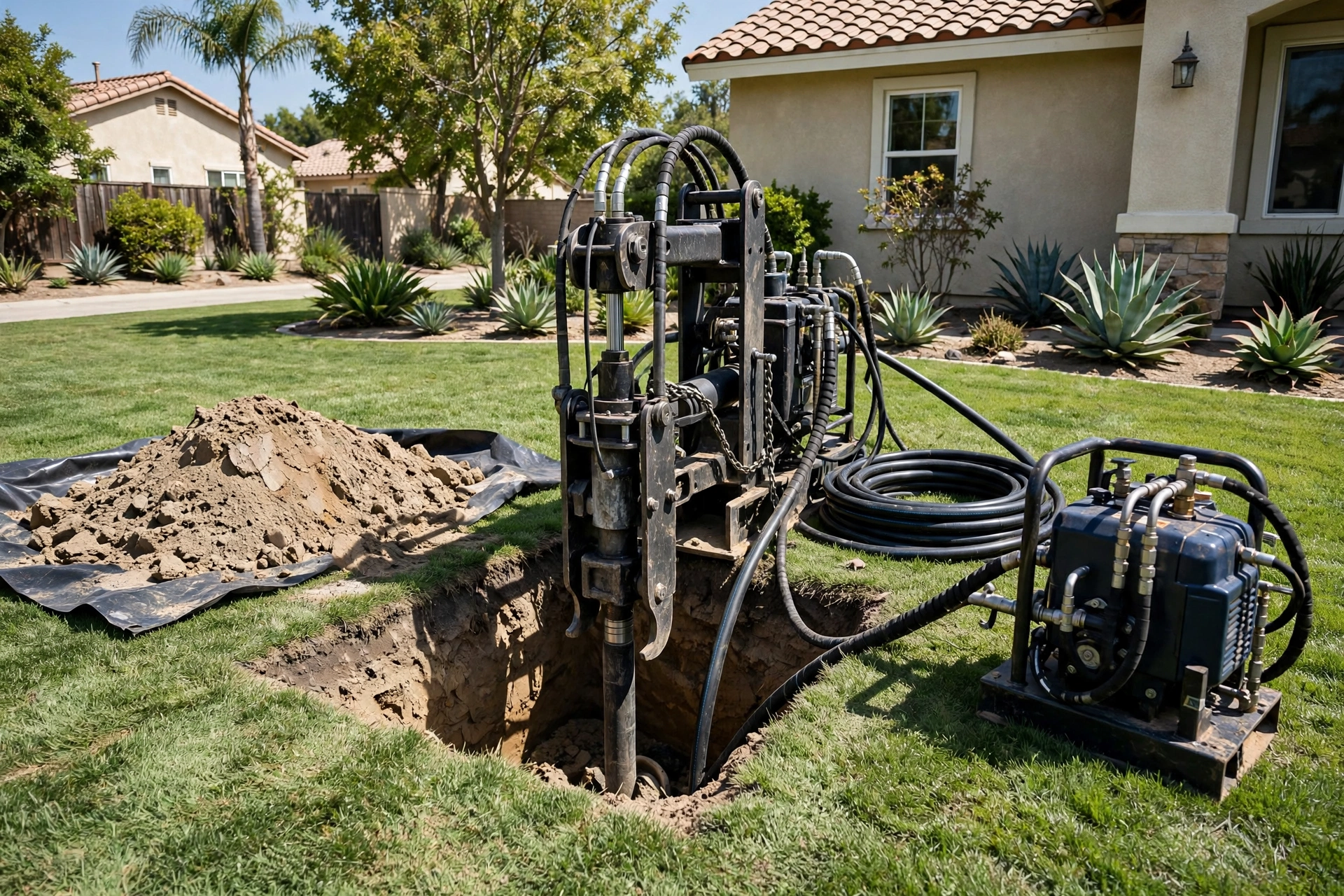
For CIPP lining: the line is thoroughly cleaned first (hydro jetting — the liner must bond to clean pipe), the resin liner is measured, saturated, and inverted into the pipe, inflated to press against the old walls, and cured. After curing, the ends are trimmed, connections reinstated with a robotic cutter (for branch connections), and a final camera run verifies the installation.
What you experience as the homeowner: 1–2 days of work, equipment in your yard but no trench across it, water service interrupted only during the final connections (usually hours, not days), and a permit and city inspection handled by the contractor — trenchless still requires both.
What Trenchless Sewer Repair Costs in the San Gabriel Valley
The California market range for trenchless is roughly $60–$250 per foot — a wide band because diameter, method (bursting vs. lining), depth, access difficulty, and lateral length all move it. For a typical 50-foot Altadena lateral, that puts most projects in the $6,000–$15,000 range all-in, which is directly competitive with open-trench replacement ($8,000–$25,000+) once you add the landscape, driveway, and hardscape restoration that trenching requires but trenchless avoids.
What drives price up: larger diameter pipe, difficult pit access, deep lines, lining with multiple branch reinstatements, and street-connection work. What drives it down: straight runs, good access at both ends, and lining (usually cheaper than bursting) when the host pipe qualifies. Get per-foot pricing in writing plus the fixed costs (pits, permits, connections, restoration) itemized — “trenchless” quotes that hide the pit and connection charges aren’t comparable. Compare with traditional excavation pricing.
Trenchless Sewer Repair FAQs
How much does trenchless sewer repair cost in Altadena?
In the California market, trenchless runs roughly $60–$250 per foot — diameter, method, depth, and access drive the range. For a typical 50-foot residential lateral, most projects land between $6,000 and $15,000 all-in. That’s competitive with open-trench replacement ($8,000–$25,000+) once you add the driveway, landscape, and hardscape restoration that trenching requires and trenchless avoids. Get per-foot pricing plus itemized fixed costs in writing.
What’s the difference between pipe bursting and pipe lining?
Pipe bursting replaces the pipe: a bursting head fractures the old line outward while pulling a brand-new seamless HDPE pipe into place — best for collapsed, badly offset, or Orangeburg pipe. CIPP lining rehabilitates it: a resin liner cures inside the old pipe into a smooth “pipe within a pipe” — best when the old pipe is intact enough to serve as a host. Bursting gives you a truly new, often larger-diameter pipe; lining is usually cheaper with even less digging. The camera footage determines which your pipe qualifies for.
How long does a trenchless sewer repair last?
Both methods are engineered for 50+ year service lives. CIPP liners carry 50-year design-life ratings; new HDPE pipe from bursting is rated 50–100 years. The jointless result is the key: with no joints, roots have no entry points — eliminating the #1 failure mode of the clay and cast-iron pipes they replace. Longevity assumes proper installation and curing, which is why the final camera verification and the installer’s warranty terms matter.
Will trenchless work if my pipe has collapsed?
Usually not — and this is the most important limitation to understand. CIPP lining needs an intact host pipe to press against, and pipe bursting needs a continuous channel for the bursting head to follow. A fully collapsed section with no remaining passage typically requires open excavation at least at that spot — a “point repair” combined with trenchless for the rest is a common hybrid. The camera inspection determines this definitively.
Does trenchless repair require a permit?
Yes. Trenchless sewer work requires the same permits and city inspection as traditional replacement in California — the city inspects the installation before pits are backfilled, and the connection at the city main must meet spec. A contractor who suggests skipping the permit is cutting the same corners they’d cut on your pipe. Permit fees are a small fraction of project cost; unpermitted sewer work creates disclosure problems at sale time.
Will my yard and driveway really be untouched?
Mostly, yes — that’s the point. Trenchless needs only small entry and exit pits (typically 4×4 feet) rather than a continuous trench, so driveways, patios, and mature trees above the run stay undisturbed. Expect minor disruption from equipment and pit restoration — not zero, but nothing like an open trench. Confirm in writing what surface restoration is included: most quotes cover backfill and compaction, not re-sodding or replanting.
Is trenchless always cheaper than digging?
No — and anyone who says so is selling. Trenchless wins on total cost when the pipe runs under expensive surfaces (driveways, patios, mature landscaping) or on long runs, because it avoids restoration costs. On short, shallow runs under plain dirt, traditional excavation is often cheaper and just as fast. Get both quotes — trenchless per-foot plus fixed costs, and open-trench including realistic restoration — and compare totals, not just the pipe price.
Sewer Line Failing Under Your Yard? Go Trenchless If You Can.
Call (888) 555-0199 — Plumbers in Altadena will connect you with a licensed Altadena plumber for camera diagnosis and honest trenchless-vs.-trench pricing. If sewage is backing up now, call our 24/7 emergency line first.
Need a Plumber Right Now?
Don’t wait for a small leak to become a big bill. Our licensed local plumbers answer 24/7 — nights, weekends, and holidays.
(888) 555-0199
Average emergency response under 60 minutes across the San Gabriel Valley