Tankless vs. Tank Water Heaters in California: True Cost at 2026 Energy Prices
Every water heater replacement forces the same question: pay less now for a conventional tank, or pay more for a tankless unit that heats water on demand? In California — with our energy prices, hard water, and seismic codes — the math is different than the national average. Here’s what the real numbers look like in 2026, so you can decide with your wallet instead of a sales pitch.
Ready to make the switch? Get tankless installation done right — or stick with a high-efficiency tank water heater.
The Sticker Price: Installed Cost in 2026
For a typical San Gabriel Valley home, here’s what licensed installation actually runs:
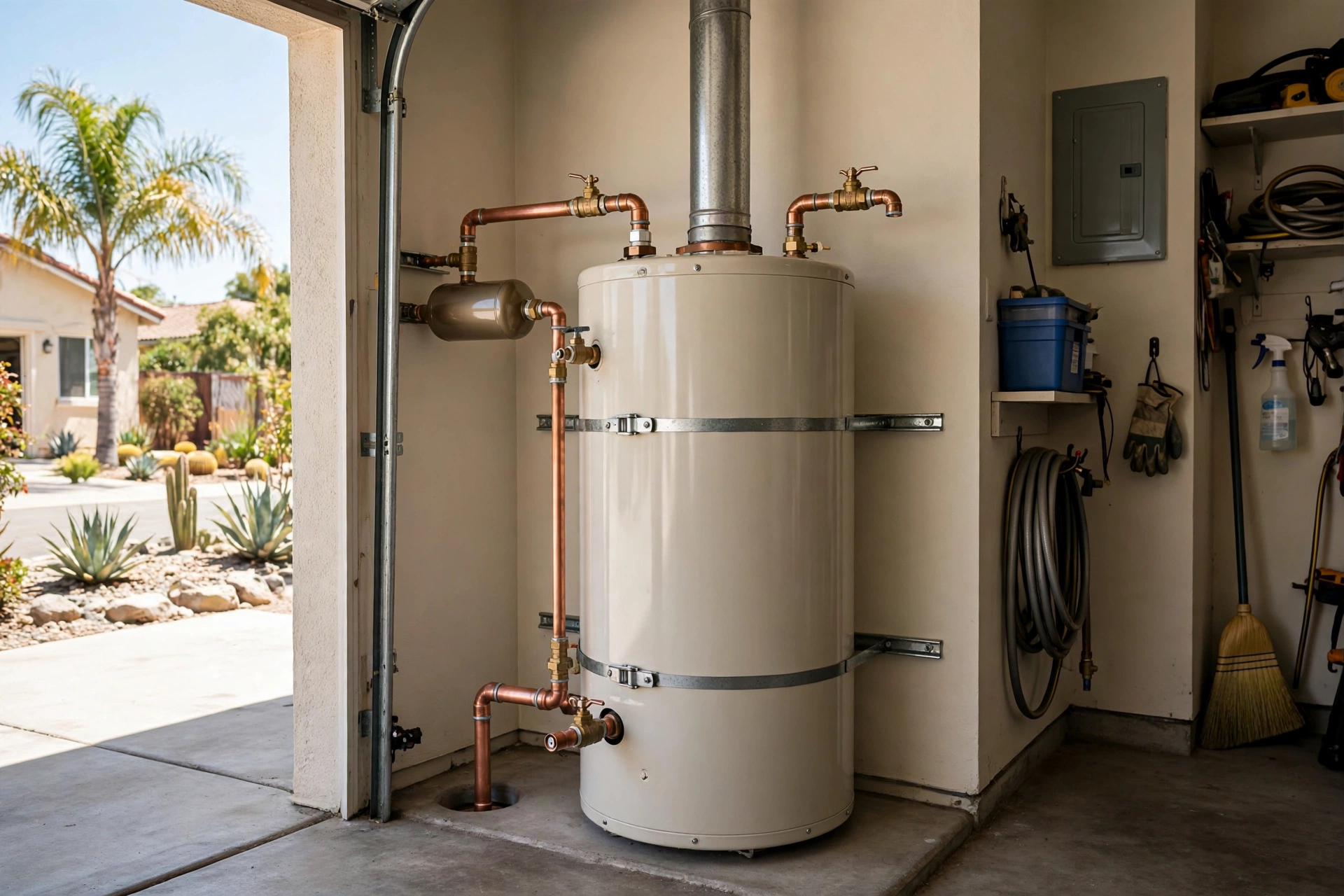
- 50-gallon gas tank heater: $1,800–$3,200 installed. Includes the unit, permit, seismic strapping, new flex connectors, and haul-away.
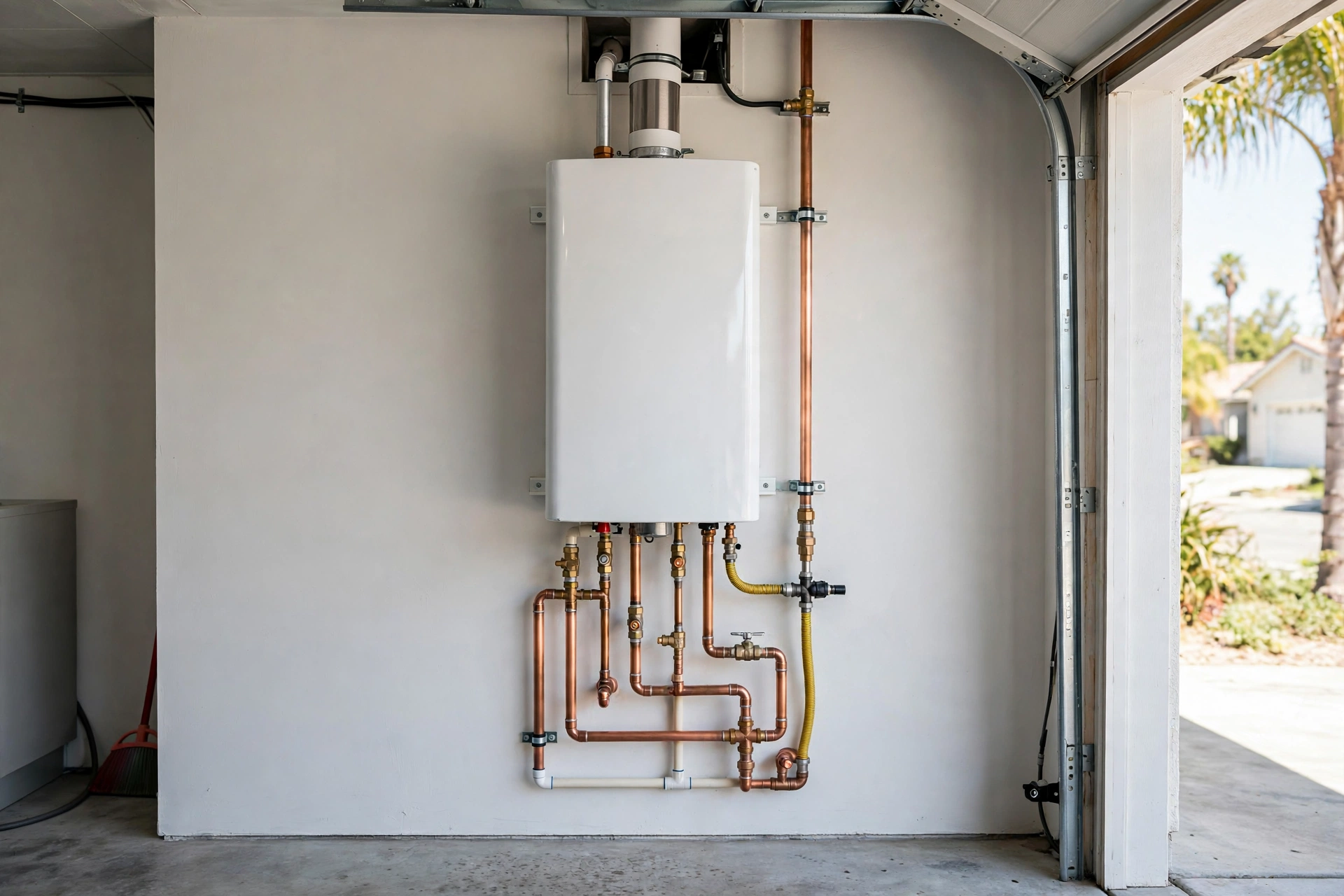
- Condensing gas tankless (whole-house): $3,800–$6,500 installed. The unit costs more, and retrofits often need a larger gas line, upgraded venting, a condensate drain, and sometimes an electrical outlet for the control board.
That gas-line upgrade is the hidden cost that surprises homeowners: most older tank heaters run on a 1/2-inch line, while tankless units firing at 180,000+ BTU typically need 3/4-inch — running a new gas line through a finished home can add $800–$2,000 by itself.
Energy Costs: Where Tankless Earns Its Keep
California gas prices remain among the highest in the country — residential SoCalGas rates have hovered around $1.50–$2.00+ per therm in recent years, with winter spikes. At those prices, efficiency matters. A conventional tank runs at roughly 60–65% efficiency and reheats 50 gallons around the clock. A condensing tankless runs at 90–95%+ and uses zero fuel when no tap is open.
Realistic savings: a family of four switching from an old tank to condensing tankless typically saves 25–35% on the water-heating portion of the gas bill — often $150–$300 per year. At a $2,000–$3,000 installed premium, payback lands in the 8–12 year range, roughly the tankless warranty advantage (12–15 year heat-exchanger warranties vs. 6–9 for tanks). For neutral efficiency data, see Energy.gov’s water heating guide.
Electric tankless is a different story — whole-house electric units demand 100+ amps and rarely pencil out in California homes with 100-amp panels and high electricity rates. Heat-pump (hybrid) water heaters, though, deserve a look: they cut electric water-heating costs roughly in half, though they need space, make some noise, and cool the room they’re in.
Hard Water: The Valley’s Tankless Tax
Here’s the part tankless brochures skip. Tankless heat exchangers are more sensitive to hard water than tanks. San Gabriel Valley water at 10–20 grains per gallon will scale a heat exchanger in a year or two without protection, triggering error codes and throttled flow. Every tankless installation in the valley should include a whole-house softener or a dedicated scale-inhibitor filter, plus annual descaling ($150–$250 as a service call). Skip maintenance and you’ll void the warranty. Tanks suffer too, but they’re more forgiving of neglect.
Endless Hot Water — With Limits
Tankless fans love the endless hot water, and it’s real: the unit heats as long as water flows. But flow rate is the catch — a mid-size unit delivers about 5–7 gallons per minute in winter when incoming water is colder, so two showers plus the dishwasher can hit the limit. Size by your household’s peak simultaneous demand, not the box’s “whole-house” claim. Tanks have the opposite profile: roughly 35–40 gallons of truly hot water from a 50-gallon tank, then 30–45 minutes to recover.
The Equipment-vs-Labor Split (and What Adds $500+)
Those installed ranges hide an important split. On a typical $2,500 tank install, roughly $1,100–$1,400 is the unit and materials (heater, pan, expansion tank, flex lines, strapping, vent connector) and $900–$1,400 is labor, permit, and haul-away. On a $5,000 tankless retrofit, the unit and materials run $2,200–$3,000 and labor runs $2,000–$3,000+ because of the gas, vent, and condensate work. When a quote seems high, ask for the split — it tells you instantly whether you’re paying for scope or margin.
Things that quietly add $500 or more to either job:
- Permit and inspection: $300–$600 in most San Gabriel Valley cities for a water heater permit; plan-check or combination permits in some jurisdictions push toward $1,000+. Any legitimate 2026 install includes this.
- Code upgrades triggered by the swap: expansion tank ($200–$400 installed), drip pan with drain line, seismic strapping to current standard, and updated venting. Inspectors flag these on replacement permits even if the old install predated the rule.
- Difficult access: heaters in tight closets, under stairs, or requiring drywall removal to reach — add $500–$1,000 in labor.
- Disposal and drywall: haul-away is usually included, but patching and texture-matching drywall opened for gas or vent runs often isn’t. Get it in writing.
What to Do Monday Morning: Your Action Steps
- Check your gas line size and panel space. Find the gas line feeding your current heater (1/2-inch vs. 3/4-inch is stamped on the pipe) and note whether the heater location can fit venting for tankless. This determines whether tankless is a $4,000 or a $6,500 job before anyone quotes.
- Get two quotes with the equipment/labor split itemized. Ask each contractor to break out unit, materials, permit, gas-line work, and labor separately — the split exposes padding instantly.
- Confirm the permit is included. Ask for the permit number and the inspection sign-off card. In 2026, an unpermitted heater install is a resale and insurance problem waiting to happen.
- Match the choice to your maintenance habits. If you won’t descale annually, buy the tank and flush it yearly instead. The best heater is the one that gets maintained.
The Bottom Line
Choose a tank if: your budget is tight, your gas line can’t be easily upsized, you want the simplest like-for-like replacement, or you won’t keep up with descaling maintenance. Tanks remain the sensible default for most valley homes.
Choose tankless if: you want to reclaim garage or closet space, your household uses a lot of hot water in bursts, you’re pairing it with a softener, and you’re comfortable with the higher upfront cost and annual maintenance.
Either way, installation is a permitted job in California — seismic strapping, proper venting, and combustion-air rules are inspected. A licensed C-36 contractor handles the permit as part of the job. Plumbers in Altadena connects San Gabriel Valley homeowners with licensed local plumbers for both options — from tankless installation to standard water heater repair and installation. Questions about your specific setup? Call (888) 555-0199 for a straight answer.
How long do tankless water heaters last compared to tanks?
Tankless units typically last 15–20 years with proper maintenance; conventional tanks average 8–12 years in hard-water areas like the San Gabriel Valley. The longer lifespan partially offsets the higher upfront cost.
Do I need a bigger gas line for a tankless water heater?
Usually, yes. Most tankless units need a 3/4-inch gas line and fire at 180,000+ BTU, while older tank heaters often run on 1/2-inch lines. The gas line upgrade is a common added cost in retrofit installations.
Does a tankless water heater need a water softener in California?
In hard-water areas like the San Gabriel Valley, strongly recommended. Scale builds up on the heat exchanger quickly at 10+ grains per gallon, reducing efficiency and voiding warranties. At minimum, install a scale-inhibitor filter and descale annually.
Are tankless water heaters worth it with California gas prices?
They can be. Condensing tankless units cut water-heating gas use 25–35% versus an old tank. At current SoCalGas rates that often means $150–$300/year in savings, with payback in roughly 8–12 years — about the unit’s warranty life.
Can a tankless unit run two showers at once?
A properly sized whole-house unit can, delivering 5–7 GPM in typical California winter conditions. But sizing matters — an undersized unit will go lukewarm with multiple fixtures running. Have your peak demand calculated before buying.
Need a Plumber Right Now?
Don’t wait for a small leak to become a big bill. Our licensed local plumbers answer 24/7 — nights, weekends, and holidays.
(888) 555-0199
Average emergency response under 60 minutes across the San Gabriel Valley